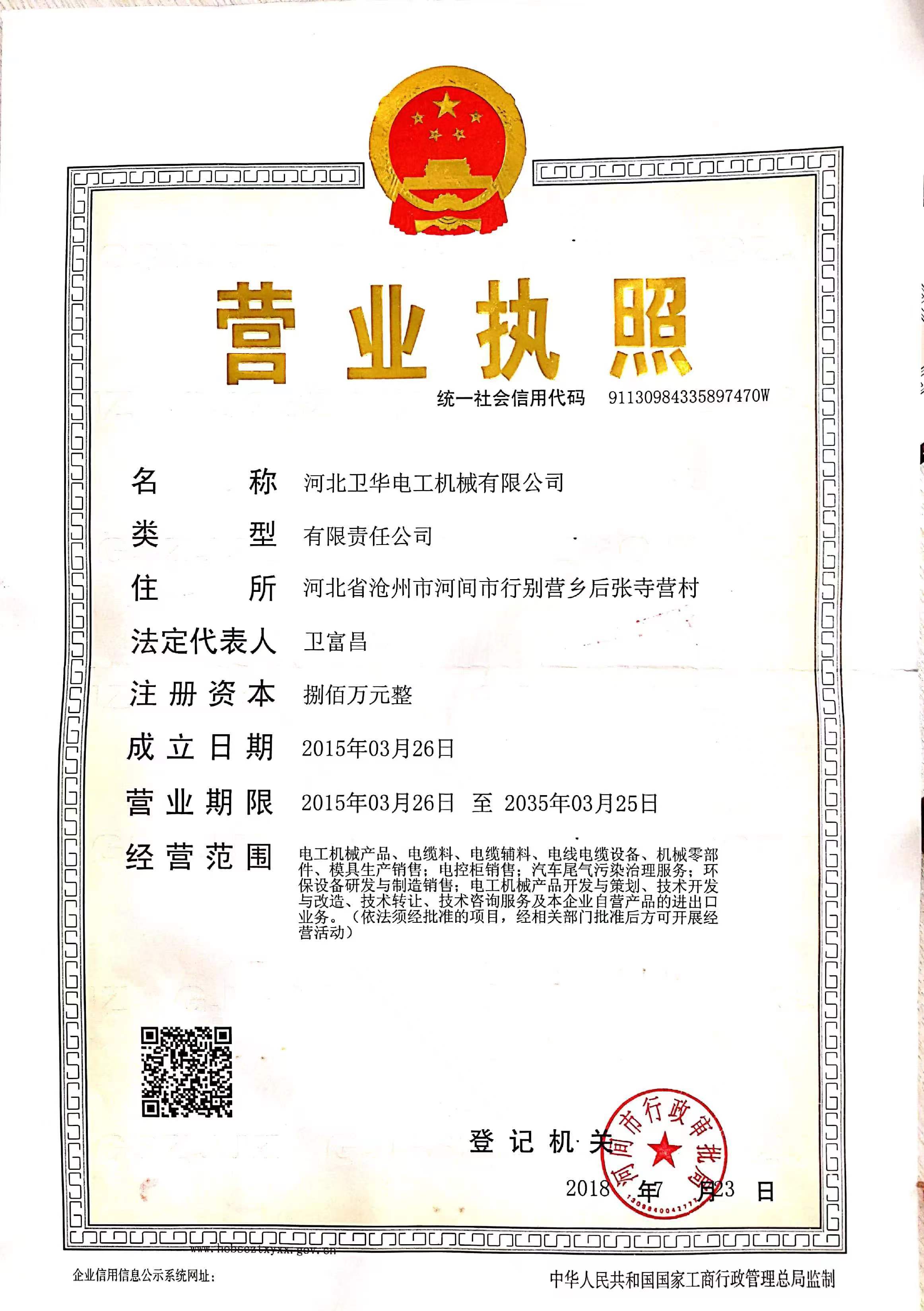
Weihua Electrical Machinery is a professional manufacturer of electrical machinery products integrating design, production, sales and service.




No boiler rubber cable production line is what?
2023-05-06 13:59
With the continuous development of science and technology, new manufacturing processes are also emerging. Among them, the non-boiler rubber cable production line is a new type of production line worthy of attention. So, what is the non-boiler rubber cable production line? Let's introduce it in detail.

1. what is no boiler rubber cable production line?
The non-boiler rubber cable production line refers to a new type of cable production line, which uses advanced technology and technology to achieve a production method that does not require boiler heating. Compared with the traditional cable production line, the non-boiler rubber cable production line has significant advantages in production efficiency and energy consumption.
Working principle of 2. non-boiler rubber cable production line
The non-boiler rubber cable production line is mainly composed of three parts, namely, extruder, rubber vulcanization device and cooling device.
First, in an extruder, a rubber material is pretreated, and the rubber material is extruded into a cable core by the extruder. Next, the cable core is transferred to a rubber vulcanizer by a conveyor belt to be vulcanized.
In the rubber vulcanizing device, the cable core is covered with a rubber sleeve and vulcanized in a high temperature and high pressure environment. At this time, the rubber sleeve will be firmly combined with the cable core to form a complete cable.
In addition, the vulcanized cable is quickly cooled by the cooling device to quickly cool it down, thereby ensuring cable quality and improving production efficiency.
Advantages of 3. Boiler-free Rubber Cable Production Line
Compared with the traditional cable production line, no boiler rubber cable production line has the following significant advantages:
1. Energy saving and environmental protection
The boiler-free rubber-sheathed cable production line does not need to use a boiler for heating, so it can greatly reduce energy consumption and reduce environmental pollution.
2. Strong stability
The rubber vulcanization device in the boiler-free rubber-sheathed cable production line adopts advanced technology and technology, which can achieve high-quality vulcanization of the cable and ensure the stability and reliability of the production line.
3. High production efficiency
Since there is no need to use boiler heating in the boiler-free rubber cable production line, the waiting time in the boiler heating process can be avoided, thereby improving production efficiency.
4. Improve product quality
The rubber vulcanization device in the non-boiler rubber cable production line can achieve high-quality vulcanization treatment of the cable, making the cable quality more excellent.
No boiler rubber cable production line is what?
recommend reading
Key Features to Look for in a Cold Feed Rubber Extruder for Electrical Wiring
Key Features to Look for in a Cold Feed Rubber Extruder for Electrical Wiring Understanding Cold Feed Rubber Extruders Cold feed rubber extruders play a crucial role in the manufacturing of electrical wiring. These machines process raw rubber materials into various forms, ensuring they meet specific standards for electrical applications. Understanding the key features of cold feed rubber extruders
Understanding Rubber Extruders: Key Insights for the Electrical Industry
In the electrical and cable industry, the rubber extruder plays a pivotal role in the manufacturing process, particularly when it comes to producing insulation and jacketing for wires and cables. A rubber extruder is a machine that shapes rubber materials into specific profiles or forms by forcing them through a die. Understanding the fundamentals of rubber extruders can significantly enhance oper
The Essential Guide to Cable Types in Production Lines
The Essential Guide to Cable Types in Production Lines Table of Contents Introduction to Cable Types in Production Lines Understanding Different Types of Cables Single-Core vs. Multi-Core Cables: Which Is Right for You? Types of Cables Commonly Used in Production Lines Power Cables Control Cables Data Cables Specialty Cables
The Essential Role of Plastic Extruders in Cable Manufacturing
Plastic extruders play a pivotal role in the modern manufacturing of electrical wires and cables, particularly in the creation of insulation and protective coatings that ensure durability and performance. These machines are designed to melt plastic pellets and then force the molten material through a die to create continuous shapes, making them indispensable in the production of various cable comp
Comparative Analysis: Different Types of Wire and Cable Extrusion Production Lines
Comparative Analysis: Different Types of Wire and Cable Extrusion Production Lines Introduction to Wire and Cable Extrusion Extrusion is a critical process in the production of wires and cables. This procedure involves forcing molten material through a die to create a continuous product with a fixed cross-sectional profile. In the context of the electrical industry, wires and cables are pivotal fo
Understanding Cold Feed Rubber Extruders: A Key Component in Electrical Wire and Cable Manufacturing
In the realm of electrical wire and cable manufacturing, the cold feed rubber extruder stands out as a pivotal technology. This specialized piece of equipment is designed to process rubber compounds at ambient temperatures, offering several advantages over traditional extrusion methods. Understanding the functionality and benefits of cold feed rubber extruders can help manufacturers optimize their