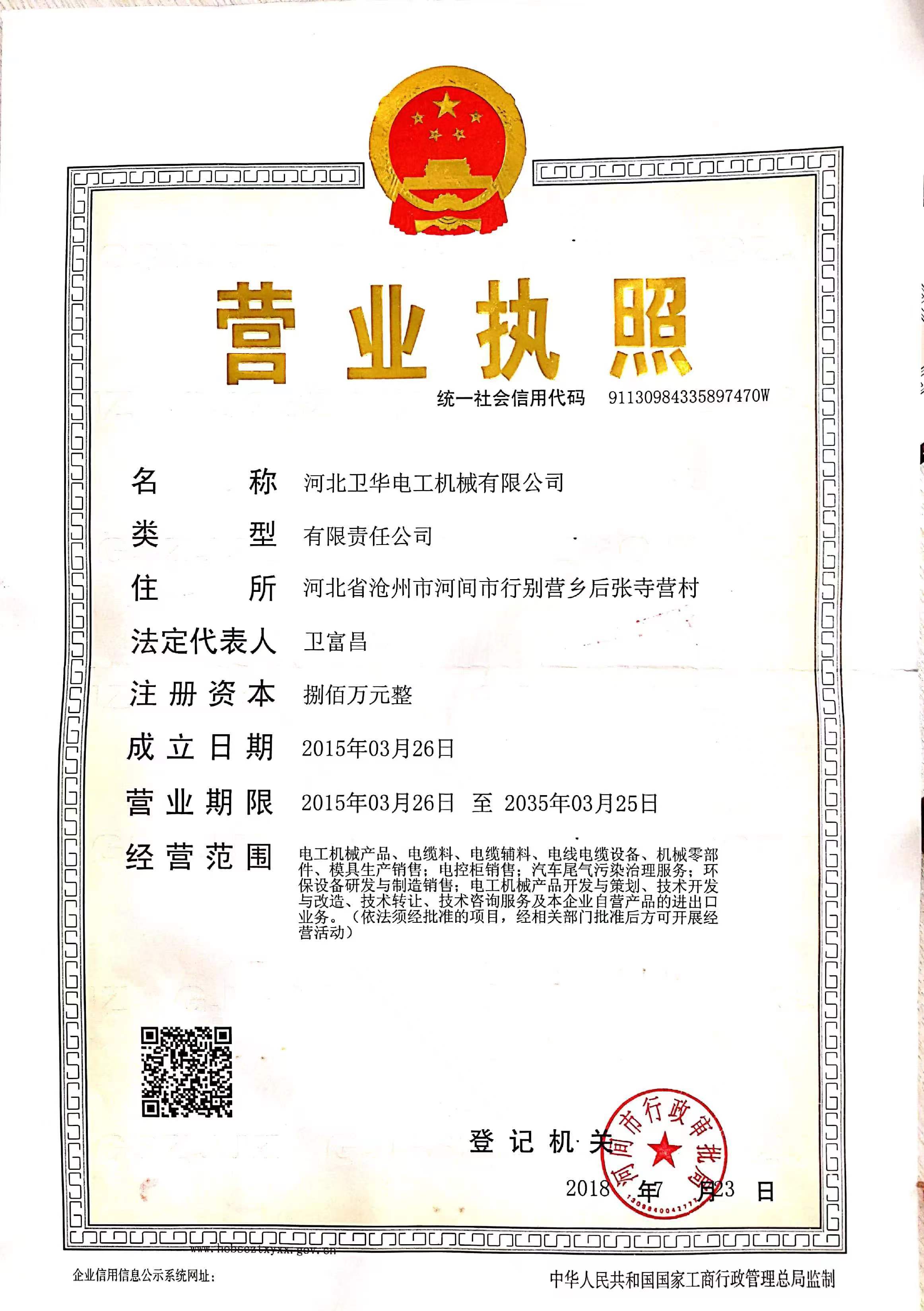
Weihua Electrical Machinery is a professional manufacturer of electrical machinery products integrating design, production, sales and service.




What are the advantages of the non-boiler rubber cable production line?
2023-04-03 11:14
The boiler-free rubber cable production line refers to the production line that uses special equipment to manufacture rubber cables. It is a production line that uses rubber or other materials as raw materials to wind and wrap ordinary wires to make rubber cables.

The boiler-free rubber cable production line has many advantages. First of all, the manufacturing process of the boiler-free rubber cable production line is simpler than that of the traditional boiler rubber cable production line, which reduces the pollution in the production process. Secondly, the boiler-free rubber sheathed cable production line can save energy because it does not require the use of boilers, which can reduce fuel consumption and reduce costs. In addition, the boiler-free rubber-sheathed cable production line has the characteristics of simple operation and fast speed, which can improve production efficiency.
In addition, the boiler-free rubber-sheathed cable production line can meet the requirements of different colors, and can produce a variety of different colors of rubber-sheathed cables, while the traditional boiler rubber-sheathed cables can only produce dark black rubber-sheathed cables. In addition, the cable produced by the boiler-free rubber-sheathed cable production line has high quality, high tensile strength and good aging resistance, which ensures the safety of the cable.
In short, the boiler-free rubber cable production line has the advantages of energy saving and environmental protection, high production efficiency, various colors are optional, and reliable quality. It is an ideal cable manufacturing equipment.
No boiler rubber cable refers to the case in the absence of a boiler, in a certain temperature and pressure conditions, the use of rubber melt on the cable sheath of the process of plasticizing melt, so as to create a cable sheath of a production line. Boiler-free rubber cable production line has many advantages, including:
1. Save energy. It can save a lot of energy because it does not use a boiler and does not need to consume energy. In addition, the production line can also use low-energy heat collection systems to reduce carbon emissions.
2. Cost savings. It does not require the use of a boiler, so it can significantly reduce production costs, such as fuel and electricity consumption. In addition, the production line can also save the cost of manpower and material resources, thereby reducing production costs.
3. Increase efficiency. It can significantly improve production efficiency because it can complete production tasks in a shorter time. In addition, the operation of the production line is also simpler, and the operator can complete the task in a shorter time.
4. Higher quality. It can provide higher product quality because it can provide stricter control, higher safety specifications and higher performance requirements. In addition, the production line can also provide higher durability, as well as better insulation and aging resistance.
5. Environmental protection. The non-boiler rubber-sheathed cable production line can be more environmentally friendly, because it does not require the use of a boiler and does not produce harmful exhaust gas and waste water. In addition, the production line can also reduce carbon more effectively and reduce carbon emissions, thereby protecting the environment.
In short, the boiler-free rubber cable production line has many advantages. It can not only save energy, reduce costs, improve efficiency, provide higher quality, but also protect the environment. Therefore, the boiler-free rubber sheathed cable production line has an important position in the cable sheath manufacturing industry, and can provide users with better products and services.
What are the advantages of the non-boiler rubber cable production line?
recommend reading
Key Features to Look for in a Cold Feed Rubber Extruder for Electrical Wiring
Key Features to Look for in a Cold Feed Rubber Extruder for Electrical Wiring Understanding Cold Feed Rubber Extruders Cold feed rubber extruders play a crucial role in the manufacturing of electrical wiring. These machines process raw rubber materials into various forms, ensuring they meet specific standards for electrical applications. Understanding the key features of cold feed rubber extruders
Understanding Rubber Extruders: Key Insights for the Electrical Industry
In the electrical and cable industry, the rubber extruder plays a pivotal role in the manufacturing process, particularly when it comes to producing insulation and jacketing for wires and cables. A rubber extruder is a machine that shapes rubber materials into specific profiles or forms by forcing them through a die. Understanding the fundamentals of rubber extruders can significantly enhance oper
The Essential Guide to Cable Types in Production Lines
The Essential Guide to Cable Types in Production Lines Table of Contents Introduction to Cable Types in Production Lines Understanding Different Types of Cables Single-Core vs. Multi-Core Cables: Which Is Right for You? Types of Cables Commonly Used in Production Lines Power Cables Control Cables Data Cables Specialty Cables
The Essential Role of Plastic Extruders in Cable Manufacturing
Plastic extruders play a pivotal role in the modern manufacturing of electrical wires and cables, particularly in the creation of insulation and protective coatings that ensure durability and performance. These machines are designed to melt plastic pellets and then force the molten material through a die to create continuous shapes, making them indispensable in the production of various cable comp
Comparative Analysis: Different Types of Wire and Cable Extrusion Production Lines
Comparative Analysis: Different Types of Wire and Cable Extrusion Production Lines Introduction to Wire and Cable Extrusion Extrusion is a critical process in the production of wires and cables. This procedure involves forcing molten material through a die to create a continuous product with a fixed cross-sectional profile. In the context of the electrical industry, wires and cables are pivotal fo
Understanding Cold Feed Rubber Extruders: A Key Component in Electrical Wire and Cable Manufacturing
In the realm of electrical wire and cable manufacturing, the cold feed rubber extruder stands out as a pivotal technology. This specialized piece of equipment is designed to process rubber compounds at ambient temperatures, offering several advantages over traditional extrusion methods. Understanding the functionality and benefits of cold feed rubber extruders can help manufacturers optimize their