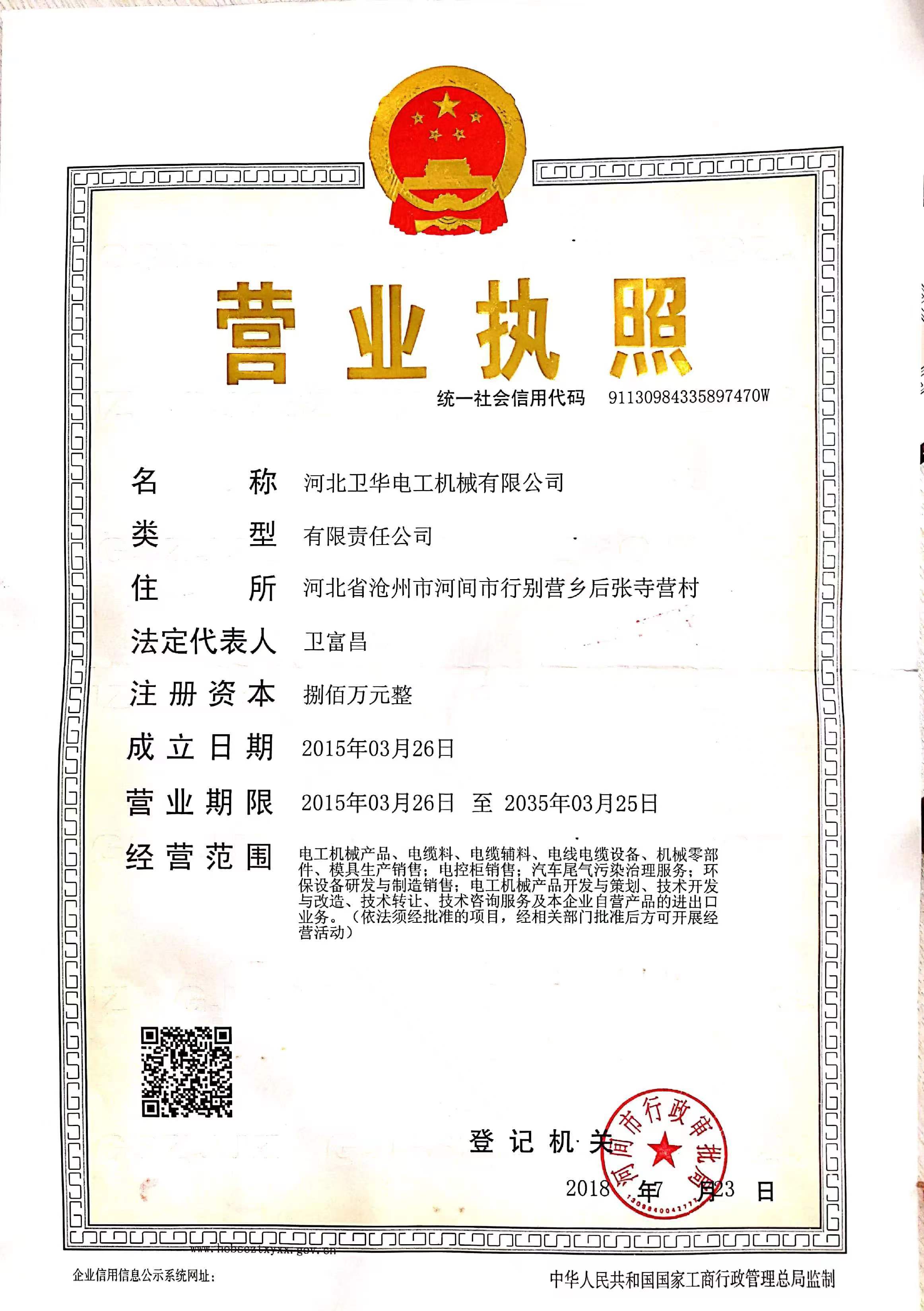
Weihua Electrical Machinery is a professional manufacturer of electrical machinery products integrating design, production, sales and service.




Rubber cable equipment industry development?
2022-12-16 13:53
rubber cable equipment industry development?

The rubber-sheathed cable equipment industry is China's second largest industry after the automotive industry, with product variety satisfaction and domestic market share exceeding90%. Worldwide, the total output value of China's rubber cable equipment has surpassed that of the United States, becoming the world's largest producer of rubber cable equipment. With the rapid development of China's rubber cable equipment industry, the number of new enterprises is rising, and the overall technical level of the industry has been greatly improved. The sustained and rapid growth of China's economy has provided a huge market space for cable products. The strong attraction of the Chinese market makes the world pay attention to the Chinese market. In just a few decades of reform and opening up, the huge capacity of China's cable manufacturing industry has impressed the world. With the continuous expansion of China's power industry, data communication industry, urban rail transit industry, automobile industry, shipbuilding and other industries, the demand for rubber cable equipment will also grow rapidly, and the future development potential of the rubber cable equipment industry is huge.2008Year11In response to the world financial crisis, the decision to invest4Trillion yuan to stimulate domestic demand, of which40%The above is used for the construction and transformation of urban and rural power grids. The national rubber cable equipment industry has a good market opportunity, rubber cable equipment enterprises around the opportunity to meet a new round of urban and rural power grid construction and transformation.
In the production process of rubber sheathed cables, there are often appearance defects such as uneven surface; clinker particles (early vulcanized rubber particles) or impurities on the surface; scratches and scratches on the surface of wires and cables; surface collapse; on the surface There are twist patterns. Here are five common causes of defects in the appearance of rubber-sheathed cables:
1.The die sleeve bearing line is too long or too short, the die is not smooth, and the aperture is too large; the head, die or body temperature is low; the low plasticity of rubber may cause the surface of the rubber sleeve cable to be not smooth.
2.The supplied rubber is not clean and contains impurities; the rubber burning time is too short; the temperature of the rubber extrusion body, head or mold is too high; the rubber in the head does not flow smoothly, and there are dead corners of the rubber material; the unsmooth screw and viscose may cause clinker particles (early vulcanized rubber particles) or impurities on the surface of the rubber cable.
3.The mold sleeve is not smooth and has no chamfer; there are impurities or rubber particles blocking the mold opening; scratches caused by dragging the pipe into the vulcanized pipe; the small aperture of the rubber gasket at the outlet of the vulcanized pipe may cause scratches on the surface of the rubber sheathed cable And scratches.
4.The aperture of the mold sleeve is too large; the gap between the strands and the single wire on the outer layer of the conductive core is too large, and the outer diameter of the cable core is uneven; the rubber material has low plasticity and poor viscosity; impurities in the rubber; the mold alignment distance is small, The pressure is small, which may cause the surface of the rubber sheathed cable to collapse.
5.The hole diameter of the mold sleeve is too small; the rubber extrusion is insufficient, and the core gap is not filled; the wire core or cable core jumper; the short distance between the two molds may cause twist on the surface of the rubber sheathed cable
The surface of the rubber-sheathed cable is smooth and clean: the top block carrier line is not too long or too short, the die is smooth, and the diameter is appropriate; the temperature of the automobile engine, the die or the shell is suitable; the rubber has good plastic deformation. The rubber material has no precipitation; the rubber does not stagnate, the screws are smooth, and the surface of the rubber sheathed cable is not easy to produce light-burned dolomite particles (early plastic material particles) or deposits. The surface of the rubber sheathed cable is not easy to scratch or scratch. The gap between the conductive strand cable and the metal wire drawing is appropriate, the cable diameter is uniform, soft, and has a certain degree of corrosion resistance. Rubber sheathed cable is a kind of flexible movable cable with multi-strand thin copper wire as conductor, wrapped with rubber insulation and rubber sheath. Generally speaking, it includes general-purpose rubber-sheathed flexible cables, welding machine cables, submersible motor cables, radio equipment cables and photographic light source cables.
Rubber cable equipment industry development?
recommend reading
Key Features to Look for in a Cold Feed Rubber Extruder for Electrical Wiring
Key Features to Look for in a Cold Feed Rubber Extruder for Electrical Wiring Understanding Cold Feed Rubber Extruders Cold feed rubber extruders play a crucial role in the manufacturing of electrical wiring. These machines process raw rubber materials into various forms, ensuring they meet specific standards for electrical applications. Understanding the key features of cold feed rubber extruders
Understanding Rubber Extruders: Key Insights for the Electrical Industry
In the electrical and cable industry, the rubber extruder plays a pivotal role in the manufacturing process, particularly when it comes to producing insulation and jacketing for wires and cables. A rubber extruder is a machine that shapes rubber materials into specific profiles or forms by forcing them through a die. Understanding the fundamentals of rubber extruders can significantly enhance oper
The Essential Guide to Cable Types in Production Lines
The Essential Guide to Cable Types in Production Lines Table of Contents Introduction to Cable Types in Production Lines Understanding Different Types of Cables Single-Core vs. Multi-Core Cables: Which Is Right for You? Types of Cables Commonly Used in Production Lines Power Cables Control Cables Data Cables Specialty Cables
The Essential Role of Plastic Extruders in Cable Manufacturing
Plastic extruders play a pivotal role in the modern manufacturing of electrical wires and cables, particularly in the creation of insulation and protective coatings that ensure durability and performance. These machines are designed to melt plastic pellets and then force the molten material through a die to create continuous shapes, making them indispensable in the production of various cable comp
Comparative Analysis: Different Types of Wire and Cable Extrusion Production Lines
Comparative Analysis: Different Types of Wire and Cable Extrusion Production Lines Introduction to Wire and Cable Extrusion Extrusion is a critical process in the production of wires and cables. This procedure involves forcing molten material through a die to create a continuous product with a fixed cross-sectional profile. In the context of the electrical industry, wires and cables are pivotal fo
Understanding Cold Feed Rubber Extruders: A Key Component in Electrical Wire and Cable Manufacturing
In the realm of electrical wire and cable manufacturing, the cold feed rubber extruder stands out as a pivotal technology. This specialized piece of equipment is designed to process rubber compounds at ambient temperatures, offering several advantages over traditional extrusion methods. Understanding the functionality and benefits of cold feed rubber extruders can help manufacturers optimize their